What Are SDS, TDS and COA in Industrial Chemical Procurement?

A Safety Data Sheet, Technical Data Sheet and Certificate of Analysis serve different decisions. Connect each document to the right procurement control.
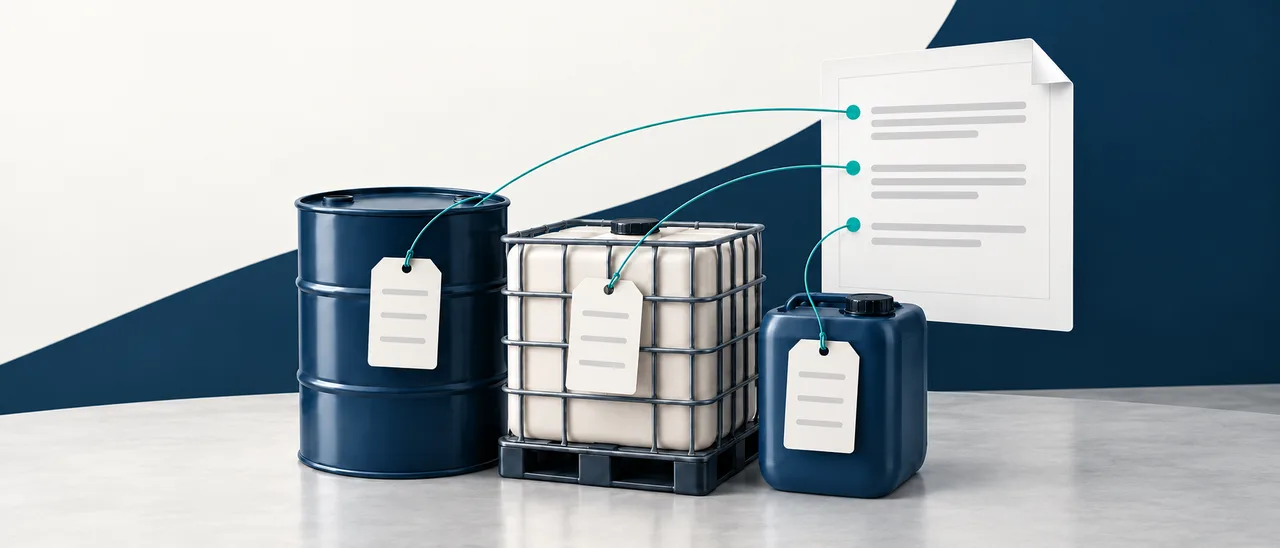
Industrial chemical procurement cannot be reduced to comparing a product name and price. Safe handling, technical suitability and verification of the delivered batch require different evidence. SDS, TDS and COA may sit in the same technical file, but they are not interchangeable. A procurement team should connect each document to a decision and acceptance point instead of merely archiving it.
This guide provides a general B2B control framework. Product classification, intended use, destination-country rules and sector requirements still require specific review. Explore the adhesives and industrial chemicals category for related products.
What is an SDS?
An SDS, or Safety Data Sheet, communicates information for safe use. Its sections address identification, hazard classification, first aid, firefighting, accidental release, handling, storage, exposure controls, physical properties, stability, toxicology, disposal and transport. An SDS is not a quality certificate and does not guarantee product performance.
Do not assume that every product automatically carries the same SDS obligation. The requirement depends on classification, composition, use and the rules of the destination market. Confirm that product identity, supplier, revision date, language and emergency details match the purchase.
What is a TDS?
A TDS, or Technical Data Sheet, explains the product's technical application and performance framework. Depending on the product, it may state appearance, density, viscosity, solids, mixing ratio, application temperature, cure time, consumption, shelf life and suitable substrates. It normally provides manufacturer-issued typical or target values, not the measured result for every delivered lot.
The technical team should convert critical parameters into written specifications before ordering. Test methods and tolerances matter: results produced by different methods may not be directly comparable.
What is a COA?
A COA, or Certificate of Analysis, reports analysis results for a defined production batch. It should identify the batch, production or analysis date, test, method, specification limit, result and approval. A generic catalogue table is not a batch COA. Match the COA batch number to the package, delivery document and ERP record.
A COA does not automatically prove laboratory competence or that one sample represents a completely defect-free batch. Contractual independent testing, retained samples or incoming inspection may be appropriate for critical materials.
Combine the three documents in one approval flow
- Before purchase, compare the current TDS with the project specification.
- Use the current SDS to plan storage, PPE, handling and transport controls.
- State acceptance criteria, test methods, tolerances and required documents on the purchase order.
- Before dispatch, match the COA and batch list with package markings.
- At receipt, record damage, labels, batch, quantity, shelf life and any incoming test.
- In the ERP, link document revision, batch and warehouse location.
Common mistakes
- Treating the SDS as evidence of product quality.
- Reading a typical TDS value as a guaranteed lot result.
- Accepting a COA without matching the batch number.
- Using an obsolete revision or unsuitable language.
- Checking that a file exists without comparing its content with the specification.
Where can AI help?
AI can classify documents, extract fields, compare revisions and flag missing evidence. It should not change a hazard classification, technical acceptance decision or regulatory conclusion without authorised expert review. Every extracted value should retain its source page and confidence level.
Frequently asked questions
Are an SDS and a COA the same?
No. The SDS focuses on hazard communication and safe use; the COA reports results associated with a particular batch.
Is every TDS value guaranteed?
Not necessarily. Read whether a value is typical, minimum, maximum or contractually guaranteed, and check the stated test method.
Does document review replace physical receipt inspection?
No. Labels, batch, packaging, quantity, damage and any required incoming test still need verification.
Continue with the construction material technical file guide.
Official sources
- ECHA guidance on compiling safety data sheets
- EU Regulation 2020/878 on REACH Annex II
- GS1 Global Traceability Standard
Move from document review to bid comparison
After checking SDS, TDS and COA, compare specification, method, sample, MOQ, packaging, remaining shelf life, Incoterm and total cost on one schedule. Use the industrial chemical quotation and supplier checklist.