How to Calculate Artificial Turf Quantity: Roll Plan and Waste Control
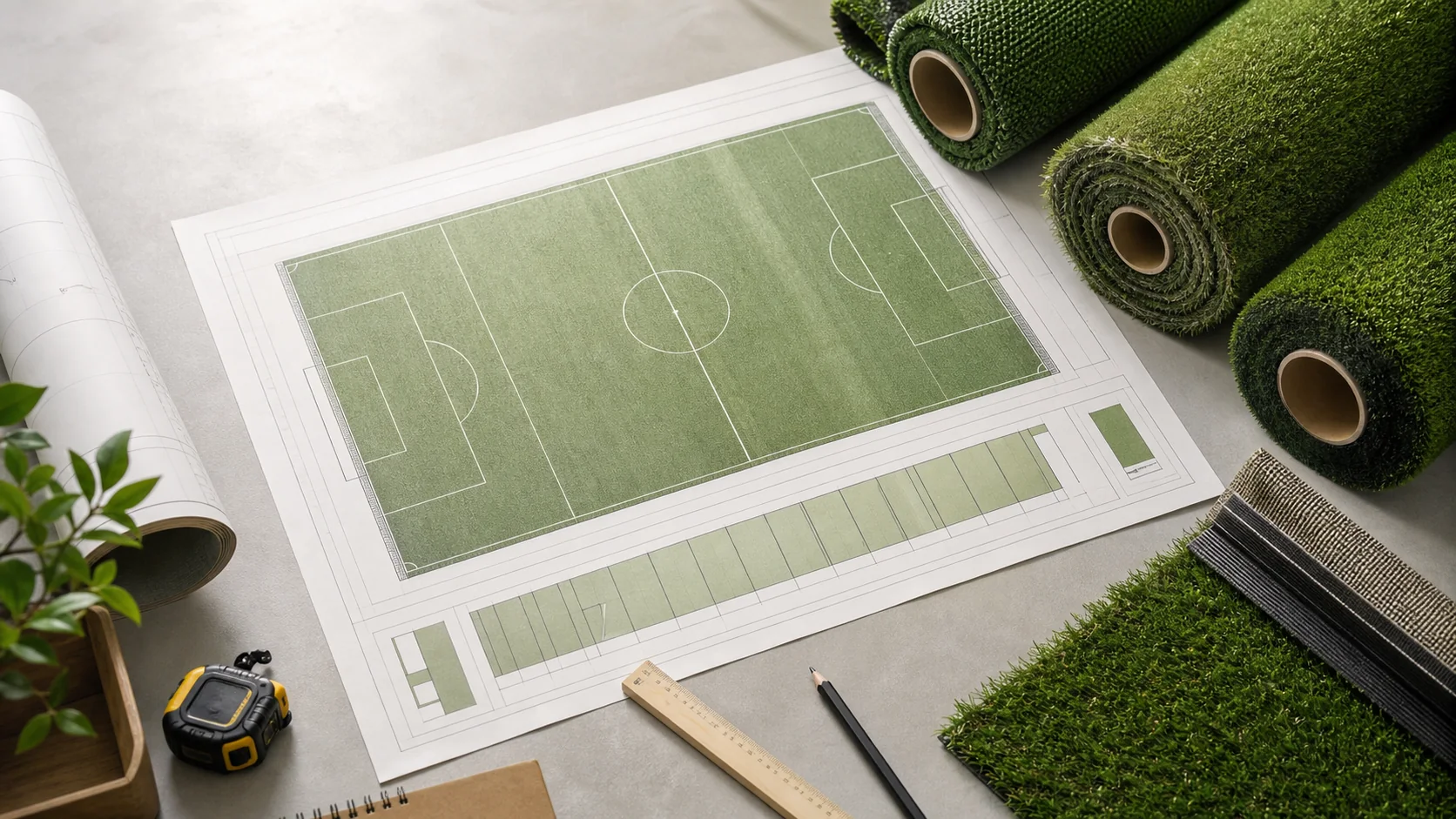
Build an auditable artificial turf bill of quantities from site geometry, available roll sizes, pile direction, seams and line-marking details.
Multiplying pitch width by length gives the net area, not the final artificial turf order. The purchase quantity must also reflect available roll width and length, pile direction, seams, line markings, perimeter returns and irregular geometry. A measured roll plan is therefore more reliable than applying one fixed waste percentage to every project.
1. Divide the installation into measurable zones
Use width × length for regular rectangles. Measure run-offs, goal areas, technical zones, walkways and different surface systems separately. Break curves and irregular edges into smaller measurable shapes. Resolve differences between drawings and site measurements before ordering.
2. Confirm producible roll dimensions
Prepare the layout around the manufacturer's confirmed roll width and maximum roll length. Record product code, production batch requirements and roll dimensions in the purchase request. An unverified roll assumption can create unnecessary seams or unusable remnants.
3. Keep pile direction consistent
Light reflects differently when turf is laid in opposite directions, creating an apparent colour variation. Mark pile direction with an arrow and maintain it across the main surface. Do not rotate small pieces merely to fill a gap unless the visual and technical consequence has been accepted.
4. Coordinate seams and playing lines
Plan seams together with high-use zones and inlaid markings. Avoid small pieces in goalmouths, centre areas and turning points. For contrasting turf lines, calculate line width, total length, cutting method and jointing tape separately.
5. Calculate waste from an offcut schedule
Waste is the difference between purchased roll area and usable installed pieces. A simple rectangle and an area with curves, pockets and colour changes cannot share the same assumption. List each roll, its cut pieces and where every remaining piece can be reused.
6. Add system accessories to the same quantity file
- Jointing tape follows measured seam length and the installation detail.
- Adhesive follows the technical data sheet, substrate and application method.
- Sand and performance infill follow the selected system specification.
- Edging, geotextile, shock pad and drainage components remain separate bill items.
7. Close four documents before purchase
Issue an approved site survey, numbered roll layout, material schedule and revision register as one controlled package. Production, logistics and installation teams can then work from the same quantities.
Frequently asked questions
Is there a standard turf waste percentage?
No single rate suits every project. Geometry, roll size, pile direction, seams and markings determine the result.
Who should approve the quantity?
Project, procurement and installation owners should jointly approve the survey and roll plan before purchase.
See the artificial turf installation quality guide and the RHB Grass portfolio.
Turn quantity planning into a comparable price
After separating net and order area, combine product, waste, basework, drainage, accessories, installation and delivery on one schedule. Use the artificial turf price-per-m² guide.
What should you include in a quotation request?
Do not send only the total area. Include a dimensioned drawing and its revision, intended use, and the selected product code or product group. Identify unconfirmed roll sizes as an open item.
- Area reference and net coverage
- Confirmed roll dimensions and quantities
- Offcuts and proposed reuse locations
- Accessories requiring a separate calculation
- Delivery city, country and unloading responsibility
- Outstanding decisions and their owners
Do not deduct an offcut from the required quantity until its dimensions and installation direction have been checked. This schedule supports comparable quotations; it does not replace the installation plan.
For RHB Grass enquiries, share your layout, intended use and delivery location through our contact page or [email protected]. Product dimensions and supply scope are confirmed separately.