How Is Artificial Turf Price per Square Metre Calculated?
Roll price alone is not the installed project cost. Separate net area, order quantity, groundworks, installation, logistics and acceptance.
Artificial turf price per square metre cannot be determined accurately from one product label or a number found online. Landscape turf, football fields, tennis areas and playgrounds require different products and system components. A quote showing only the turf roll may exclude base preparation, drainage, infill, seams, lines, installation, freight and acceptance.
This article is not a fixed market price; it is a method for building a comparable quotation. A firm price requires confirmed product, quantity, destination and site conditions. Use the artificial turf quotation comparison checklist alongside this calculation.
1. Define the intended use
The first question is not simply area. A decorative garden, busy walkway, school, multi-sport court or football facility can require different pile height, yarn, density, backing, infill and performance. Similar-looking products are not automatically equivalent. Compare current technical data and representative samples.
2. Separate net area from order area
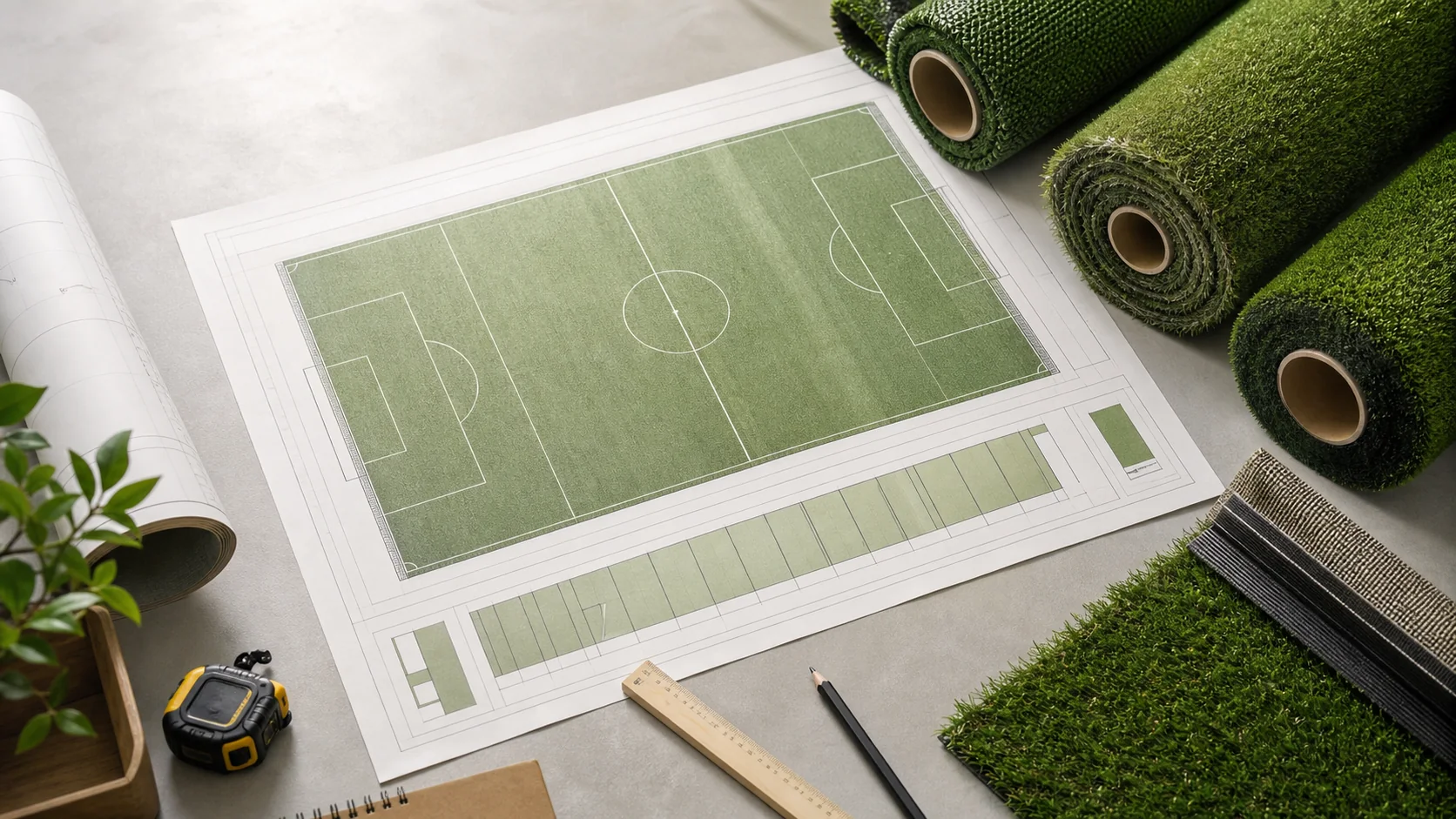
Net area is the geometric surface to be covered. Order area follows roll width and length, laying direction, seams, markings, edge returns and cutting waste. A rectangle and an irregular landscape do not have the same waste. Instead of inventing one percentage, prepare a scaled roll-layout plan.
The basic relationship is: order area equals complete roll layout plus cuts and details. Product cost is order area multiplied by the quoted product rate. Show net area, order area and usable remnants separately.
3. Read what the product rate includes
State whether the rate covers only rolls or also adhesive, seaming tape, line turf, sand, performance infill or shockpad. Identify currency, tax treatment, packaging, loading and validity. Two identical rates may represent different technical values and accessory scope.
4. Survey base preparation separately
Removal, excavation, fill, grading, compaction, kerbs, concrete or asphalt and level correction are often outside the product rate. A weak or uneven base can cause ponding, settlement and seam stress. FIFA installation guidance identifies quality basework, drainage and sub-base construction as necessary for installation longevity.
5. Price drainage and water management
Falls, channels, pipes, geotextile, permeable layers and discharge points depend on the site. Perforated turf backing alone does not guarantee that water leaves the field; the underlying build-up and outlet capacity must work together. Attach a drawing, quantities and responsibility boundary.
6. Expose installation items
- Unloading, site movement and temporary storage of rolls
- Laying direction, cuts, tape and adhesive
- Lines and logos
- Sand and performance infill quantity and spreading
- Brushing, adjustment and final cleaning
- Crew travel, equipment, access and safety controls
Identify the installer and the treatment of delay caused by weather or an unready site. Delivery of material is not acceptance of the finished surface.
7. Calculate logistics to the real destination
An ex-works rate may require inland haulage, export packing, port, freight, insurance, customs, terminal, site transport, unloading and waiting charges. State the Incoterm with a named port or place. Roll dimensions affect volume and vehicle or container utilisation as much as weight.
8. Separate capital and life-cycle cost
Maintenance equipment, brushing, infill top-up, local repair, remarking, tests, cleaning and planned replacement sit outside the initial rate. Playing hours and maintenance frequency can affect warranty. The lowest capital price may not create the lowest whole-life cost for a busy facility.
9. Do not confuse product evidence with field outcome
A listed product or system does not automatically certify every installed field. The FIFA Quality Programme separates laboratory product testing from final field testing. If certification is required, confirm the current programme, eligible providers, accredited institute, field test and warranty link before tender.
Comparable quotation schedule
- Net project area and order area
- Product code, specification and roll size
- Basework, drainage and edge details
- Accessories, infill, lines and equipment
- Installation, testing and acceptance
- Transport, customs, unloading and named destination
- Tax, currency, payment and validity
- Warranty, maintenance and exclusions
Share the drawing, dimensions, intended use and delivery point through the RHB Group contact page for a scope-aligned quotation.
Frequently asked questions
Can I multiply net area by the turf rate?
No. Order waste, basework, drainage, accessories, installation and logistics remain separate.
Is a taller pile always better?
No. Intended use, yarn, density, backing, infill and system performance must be assessed together.
When does the price become firm?
When product, measured quantity, site scope, destination, currency and commercial terms are confirmed in writing.