Private-Label Detergent Quality and Technical File Guide
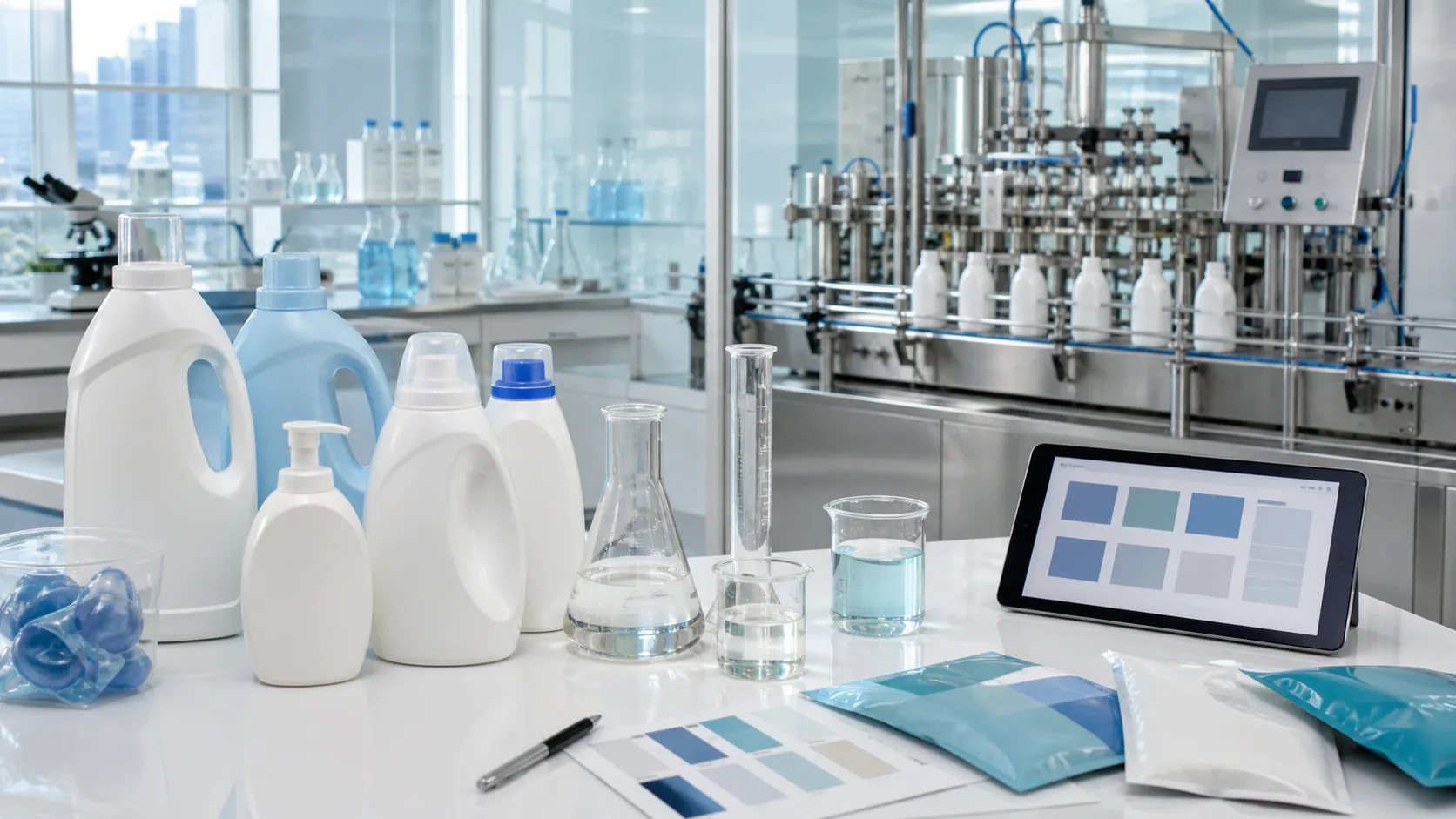
Private-label detergent is more than package design. Control formula approval, testing, labels, batches and destination-market requirements through clear gates.
A private-label detergent project is not simply a logo applied to a ready bottle. Intended use, formula, raw materials, performance tests, packaging compatibility, labels, batch traceability and destination-market rules must be managed together. Skipping these gates to obtain the lowest unit cost can create relabelling, leakage, complaints or blocked inventory.
The following is a general project checklist; authorised technical and regulatory specialists must confirm compliance for the specific product and market. Use the contact page to discuss a defined project scope with RHB Group.
1. Turn the product brief into measurable criteria
State whether the product is for household or professional use, the target surface, dosage format, fragrance, colour, pack size, cost target and destination market. Replace broad wording such as “powerful cleaning” with a testable performance requirement. Define the intended use scenario and acceptance threshold rather than attempting to copy a competitor.
2. Control formula and raw-material changes
Freeze the approved sample's formula code and revision. Record supplier, specification and substitution rules for critical raw materials. A cost-driven substitution may affect appearance, fragrance, viscosity, packaging compatibility, stability or label data. Do not release mass production without change control and re-evaluation.
3. Separate performance and safety controls
Select cleaning, foam, rinse or stain-removal tests according to intended use. Assess pH, viscosity, density, appearance and microbiological risk as distinct quality controls. The report should define method, sample conditions and acceptance limit. One successful sample does not establish a complete shelf life or every possible use condition.
4. Test packaging compatibility before production
Evaluate bottle, closure, seal, pump and label together with the formula and storage conditions. Check leakage, panel deformation, colour transfer, label lift and dosing errors. Include carton, pallet and container stacking in the logistics test plan.
5. Manage labels and technical files by market
Verify product name, directions, dosage, warnings, ingredient disclosure, responsible economic operator, quantity, batch and contact fields for the destination. Text accepted in one country is not automatically suitable in another. Products requiring hazard classification remain subject to the relevant chemical classification and labelling rules.
The EU has published Regulation 2026/405 on detergents and surfactants. Its general application begins on 23 September 2029. The current Regulation 648/2004 continues to matter until then, together with transition provisions. Data architecture can prepare for future elements such as the digital product passport, but a future requirement should not be represented as if it already applies in full.
6. Use a pilot batch and golden sample
Evaluate a pilot batch across formulation, filling, closure torque, labelling, case and pallet steps. Retain the approved sample, print proof and measurement results as controlled references. The production lot must have an explicit comparison basis.
7. Build a batch-release file
- Raw-material and packaging lots
- Production formula and revision
- Process and filling records
- Finished-product test results
- Label and artwork version
- Produced, rejected and dispatched quantities
- Retained sample and release approval
8. Support the process with ERP and AI
The ERP should connect formula revision, raw-material lot, production order, quality result and customer label in one batch genealogy. AI can compare artwork text, flag missing fields and summarise complaint trends. Formula changes, batch release and regulatory approval must remain authorised human decisions.
Frequently asked questions
Does a brand owner have no responsibility in outsourced production?
No. Roles differ by market, but manufacturer, brand owner, importer and distributor responsibilities should be explicit in contracts and the compliance matrix.
Is a package sample enough?
No. Test the package with the formula, filling process, storage duration and transport conditions.
Does the new EU regulation fully apply today?
No. Regulation 2026/405 has been published, but its general application date is 23 September 2029. Separate transition planning from current obligations.
See the SDS, TDS and COA guide for batch documentation.
Official sources
- EU Regulation 2026/405 on detergents and surfactants
- EU Regulation 648/2004 on detergents
- GS1 Global Traceability Standard
Turn the quality plan into a manufacturing RFQ
Once formula and batch controls are clear, send manufacturers the same brief, packaging, MOQ, testing, lead-time and delivery scope. Follow the private-label detergent manufacturing RFQ guide.