Football Pitch Drainage and Sub-Base Design Guide
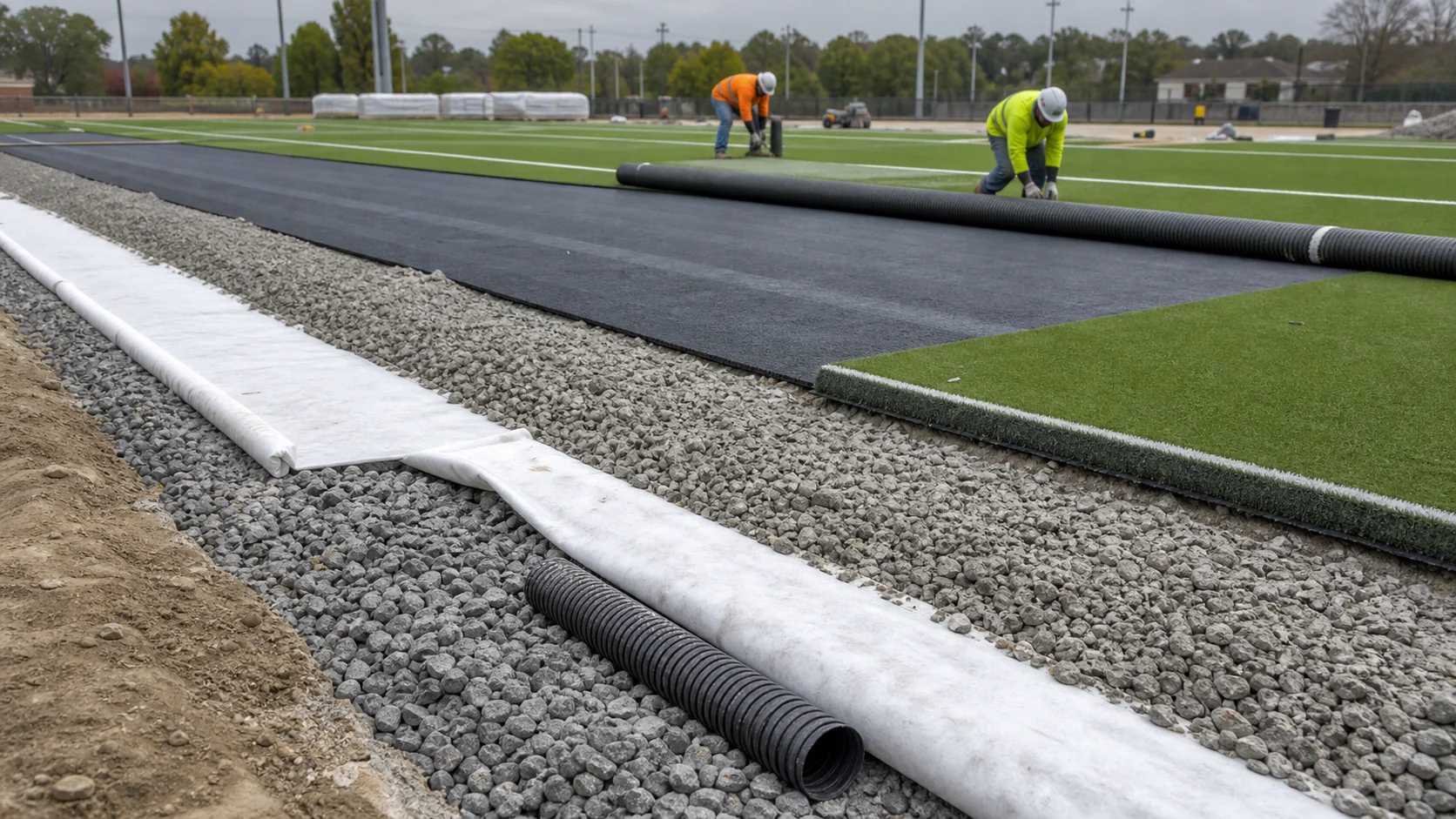
Plan investigation, drainage routes, geotextile, stone layers, compaction, levels and acceptance before installing artificial turf.
Water ponding, surface waves and seam failure on artificial-turf pitches often originate below the carpet. A successful pitch collects rainfall, keeps structural layers stable and preserves surface tolerances throughout its operating life.
1. Survey the ground and levels
Existing levels, soil type, groundwater, external runoff and the final discharge point must be known before layer thicknesses are selected. Water from surrounding areas should be prevented from entering the field, while water within the field needs a legal and technically suitable exit.
2. Select the drainage approach
Projects may use perimeter drainage, herringbone pipes, a vertical drainage layer or a combination. Pipe diameter alone is not a design. Gradient, perforation orientation, filter material, maintenance access and outfall capacity must be calculated together.
3. Specify geotextile and filters
Geotextile limits the migration of different aggregate sizes and provides filtration. An unsuitable product can reduce flow or clog over time. Verify tensile strength, permeability and soil-filter compatibility in the technical data.
4. Build the structural sub-base
Aggregate grading, layer thickness and compaction influence both bearing capacity and drainage. Material should be placed and compacted in controlled layers rather than one thick lift. Record the level and compaction result for each layer.
5. Verify slope and tolerance
The surface needs enough fall to direct water without disturbing play. Use laser-level or equivalent measurements to correct high and low points before turf installation. Repairing a base after the carpet is laid is far more expensive.
Quality-control checklist
- Setting-out of start and finish levels
- Drain-pipe gradient and connection checks
- Geotextile overlaps and damage inspection
- Layer thickness, delivery and compaction records
- Final tolerance survey and water test
- Accessible chambers and discharge points
Review RHB Group’s drainage and turf sub-base components or share site investigation and field dimensions with our technical team.